
The Best Vibecoding Stack for 2026
TL;DR
Laravel's opinionated defaults eliminate the decision fatigue that cause AI coding agents to hallucinate or make poor architectural choices. Combined with tools like Laravel Boost, PHPStan, Inertia.js, and Laravel Cloud, you get a stack where AI can follow a well defined path instead of guessing at it.
I've spent the last year vibecoding everything. An Obsidian plugin in pure TypeScript. A macOS application. Multiple internal tools. A full SaaS. And after all of that, I can tell you with confidence: nothing lets you move faster than Laravel.
I know that's a strong claim. I built my first SaaS in Next.js many years ago. I've used Astro for my blogs. I've written services in Go, shipped native iOS and macOS apps, and even dabbled in Python when I need their AI tooling.
But for creating web applications? Laravel is the best and it's not even close.
Your AI is only as good as the decisions it doesn't have to make. Every time an LLM has to choose between competing patterns, pick a library, or figure out how to wire things together, that's where things can go wrong. The numerous external services you need to sign up for. The weird architectural choices. The code that looks right but falls apart the moment you try to extend it.
Laravel has built in defaults for almost everything. And when you're vibecoding, that's not a limitation. It's a superpower.
#Laravel Boost
I'll address the elephant in the room first. LLMs are generally better at writing modern JavaScript. They've seen more of it in training. More React, more TypeScript, more Node. That's just a fact.
But Laravel has something that changes the equation: a first-party package called Laravel Boost.
Boost generates dynamic AGENT.md files based on which first-party packages you actually have installed. Using Sanctum for auth? It knows. Using Horizon for queues? It knows. Project-specific context, not generic documentation.
It also provides an MCP server that gives your AI direct access to semantic documentation search, your database schema, browser errors, and more. With Boost, the JavaScript training gap is completely closed.
#Strong Types with PHPStan
Something people who haven't touched PHP in a decade might not realize: PHP has types now. Real types.
With PHPStan and its Laravel-specific extension Larastan, you get TypeScript-level static analysis.
1// App\Http\Controllers\UserController2 3public function show(int $id): User4{5 return User::find($id); // PHPStan error: Method returns User|null, not User6}Your AI makes mistakes. PHPStan catches them immediately and automatically. Type mismatches, null safety issues, and incorrect method signatures can't hide from static analysis.
I add a rule to my CLAUDE.md file telling the agent to run PHPStan after every change. No waiting until runtime to discover the AI hallucinated a method signature.
#Opinionated Defaults
Database access? Use eloquent. Caching? Built in. Migrations? Standardized. Testing? Ready out of the box. Queues, emails, notifications, scheduled tasks? All first-party.
And then there's authentication. You know how much boilerplate and decision-making goes into setting up auth in a Node project? In Laravel it's all built into the framework.
When you ask an AI to "add a feature that sends an email when a user signs up," it doesn't have to decide which email library to use, how to configure it, or where to put the code. There's one way to do it. The Laravel way. Documented extensively. With conventions the AI is already familiar with.
#Inertia.js and React
You still get the entire React ecosystem. Shadcn. TypeScript. All of it. When you build a Laravel application with Inertia.js you can use React for the frontend where it excels with Laravel handling everything else.
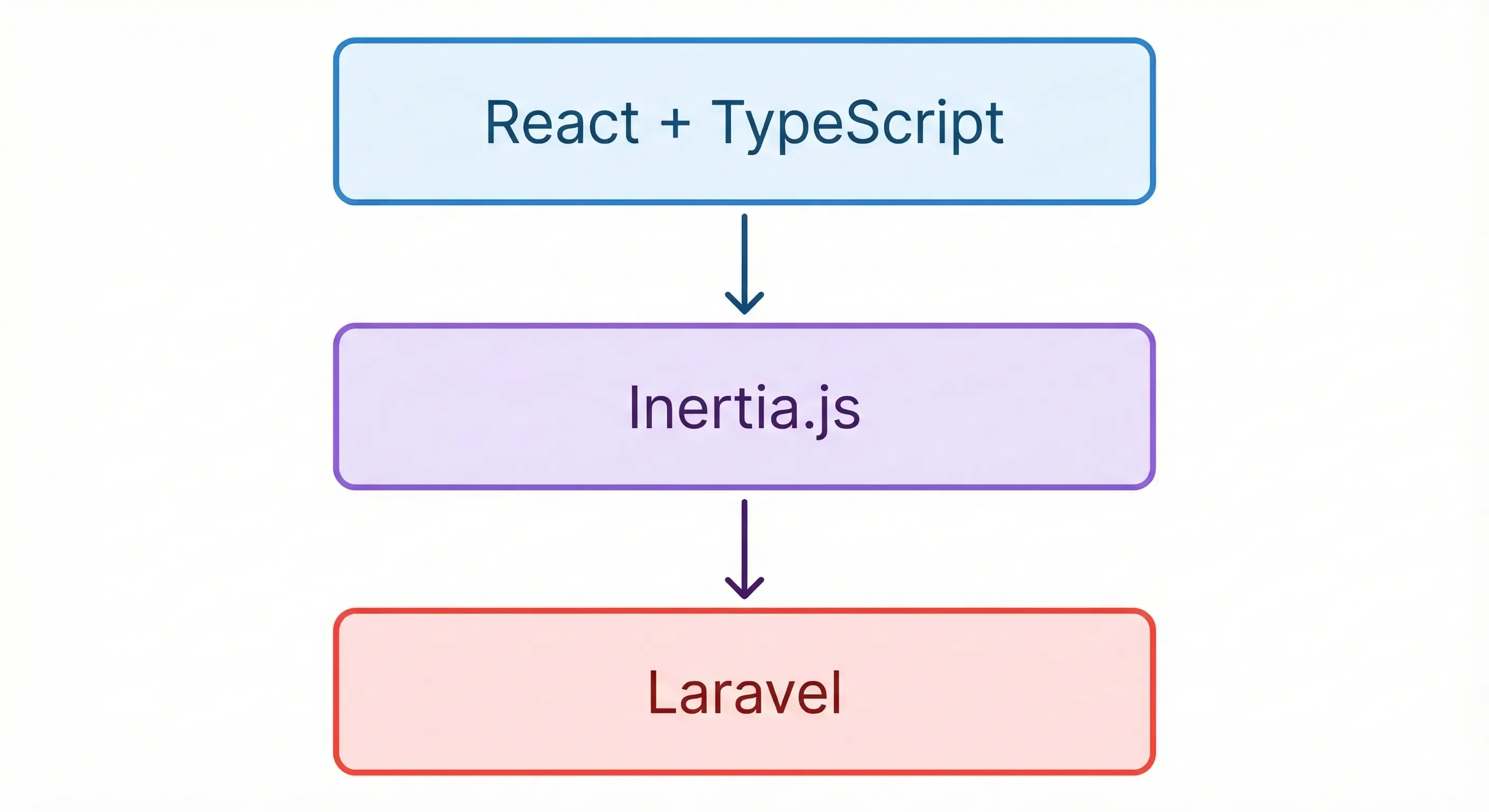
Add in Wayfinder and it makes things even better. Wayfinder generates TypeScript types from your Laravel routes. When your AI writes a frontend component that calls an API endpoint, TypeScript knows exactly what that endpoint expects and what it returns.
1// Generated by Wayfinder - full type safety 2import { useForm } from '@inertiajs/react' 3import { store } from '@/actions/App/Http/Controllers/UserController' 4 5const form = useForm({ 6 name: 'Ben', 8}) 9 10form.submit(store()) // POST to /users with full type checkingYou're not giving up React. You're pairing it with a backend that handles all the hard stuff for you. With full type safety from database to browser.
#Deployment with Laravel Cloud
It used to be that deploying a Next.js app on Vercel was dramatically easier than deploying Laravel. That's not true anymore.
Laravel Cloud gives you hosting, database, cache, queues, and websockets in a simple deployment. You can deploy a brand-new site in under a minute. You push code, it runs.
For local development, Laravel Herd sets up your environment with a single install. No Docker configuration, no Vagrant, no wrestling with PHP versions. It just works.
#First-Party Paradise 🌴
As serial product builder Josh Pigford pointed out, the Next.js world is "VERY heavy on 3rd-party-services."
Look at what a typical Next.js project requires: Clerk or Auth0 for authentication. Supabase or PlanetScale for your database. Upstash for Redis and queues. Resend or Postmark for email. Pusher or Ably for websockets. Inngest or Trigger.dev for background jobs. Uploadthing for file uploads. Algolia for search.
That's eight different accounts. Eight different dashboards. Eight different billing relationships. And when you sell the project? Good luck transferring all of that.
With Laravel Cloud, everything lives in one place. Your database, Redis, queue workers, websocket server, scheduled tasks, and file storage all live in the same dashboard on one bill. Auth, email, notifications, and search are first-party Laravel packages.
When you ask your AI to "add real-time notifications," it doesn't have to figure out which websocket service to use. It just uses Reverb.
Nothing beats Laravel.